
One of the most frustrating things about distracted driving accidents is knowing that these accidents are completely preventable. A relatively new law in Pennsylvania called Paul Miller’s Law seeks to limit the number of these crashes and imposes liability when people make the dangerous decision to engage in distractions while behind the wheel. Cousin Benny Personal Injury stands beside victims of distracted driving accidents and can seek to hold drivers accountable when they harm our clients.
What Is Paul Miller’s Law?
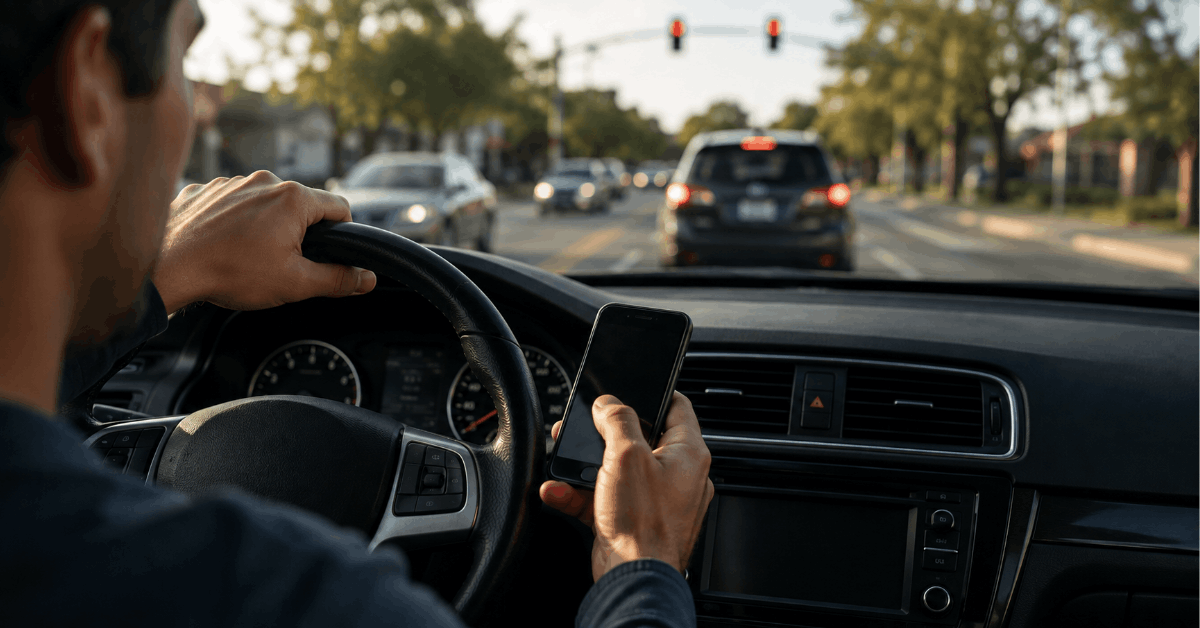
Paul Miller’s Law is a state law that prohibits drivers from holding or supporting any electronic device while operating a motor vehicle in Pennsylvania. This law helps align the state’s traffic safety regulations with current technology and with other states that have already adopted hands-free driving laws.
The law was named after Paul Miller Jr., who was killed in a fatal car crash with a tractor-trailer in 2010 when a distracted driver was reaching for their phone while driving. Since his death, his mother has become a national advocate for stronger laws to prevent distracted driving. The intent of the law is to prevent senseless deaths and serious injuries caused by distracted driving.
The law became effective on June 5, 2025, allowing law enforcement to begin issuing written warnings for violations. Beginning June 6, 2026, law enforcement officers began being able to issue summary citations to those who violated the rule.
This law is in addition to Pennsylvania’s existing texting-while-driving ban, which prohibits drivers from using mobile devices to send, read, or write text-based communications while driving a vehicle in motion.
What Is Distracted Driving?
According to the National Highway Traffic Safety Administration (NHTSA), distracted driving is “any activity that diverts attention from driving…anything that takes your attention away from the task of safe driving.”
Dangers of Distracted Driving
Distracted driving has serious consequences. The NHTSA reports that distracted driving was responsible for 3,208 traffic fatalities in 2024, along with injuries to 315,167 people. PennDOT data shows that 9,950 crashes involved a distracted driver in 2024, which resulted in 6,000 injuries and 49 fatalities.
The NHTSA warns that people cannot drive safely unless the task of driving has their full attention and that any non-driving activity they engage in is a potential distraction that increases their risk of crashing. It also states that texting is the most alarming distraction, noting that sending or reading a text takes a driver’s eyes off the road for at least five seconds, which is the entire length of a football field when traveling at 55 mph.
Common Types of Distracted Driving
The Centers for Disease Control and Prevention (CDC) classifies distracted driving into three categories, as follows:
Manual Distractions
Manual distractions involve anything that takes the driver’s hands off the wheel, such as:
- Fiddling with the radio
- Adjusting temperature controls
- Opening a map
- Eating or drinking
- Inputting information into a GPS device
- Texting
- Reaching for a dropped object
- Inputting numbers to make a telephone call
- Petting an animal or tending to a child in the vehicle
Visual Distractions
Visual distractions take the driver’s eyes off the roadway, such as:
- Looking in the backseat at a child or pet
- Looking beside you at a passenger
- Looking at the infotainment system
- Looking outside the window
- Looking down at a phone
- Looking at a GPS unit
Cognitive Distractions
Cognitive distractions take the driver’s mind off the task of driving and may involve any of the following:
- Being lost in thought or daydreaming
- Having a heated argument in the vehicle or on the phone
- Thinking about text messages or social media messages
Texting and talking on a cell phone are particularly dangerous forms of distracted driving because they can involve all three types of distractions.
Key Aspects of Paul Miller’s Law
Paul Miller’s Law contains several key provisions, including:
- Electronic devices: The law applies to various interactive mobile devices, not just cell phones. This includes tablets, GPS units, and other devices capable of text-based communication or video display. In this way, the law updates Pennsylvania law to reflect the most recent technology and driving habits.
- No motion requirement: Unlike the texting law, the vehicle does not have to be in motion for Paul Miller’s Law to apply. It applies whether the vehicle is moving, stopped in traffic, or at a red light.
- Hands-free requirement: If a driver wants to use technology in the vehicle, they must use Bluetooth, voice-activated technology, or dashboard mounts to avoid running afoul of the law.
- Video use prohibition: The new law specifically bans using a device to watch or record a video while operating a vehicle.
- Ban on manual typing: Drivers are precluded from sending, reading, or composing text messages, social media messages or posts, or emails while driving. Additionally, they cannot dial or answer a phone or other device if doing so requires pressing more than one single button.
- Emergency exceptions: Drivers can use a handheld device to contact emergency services or law enforcement to prevent bodily injury or property damage.
- Preemption: The state law supersedes any similar local ordinance.
- No double jeopardy: A person cited for violating this law cannot also be charged with violating the text-based communication law for the same offense committed at the same time and place.
- Pull-over permission: A person does not violate this law if they move their vehicle to the side of or off of a highway, stop, and use the device while the vehiclisas stationary.
- Prohibition on reaching over: It is also a violation of the law to reach for an interactive mobile device in such a way that the driver is no longer in a seated driving position or restrained by a seat belt.
Penalties for Violations
Law enforcement officers can stop motorists whom they observe violating the law and ticket them. A first offense carries a fine of up to $50, but subsequent offenses can result in increased fines and points added to their driving record. Drivers in violation of the law could face enhanced penalties if the violation caused a crash resulting in serious injury or death.
How a Violation of Paul Miller’s Law Can Impact a Personal Injury Case
Drivers who violate the new distracted driving law could be found liable for the harm they cause to other motorists or road users if their distraction causes an accident. This is due to a legal concept known as negligence per se.
Typically, to establish negligence, a personal injury victim has to show that the defendant:
- Owed them a duty of care
- Breached the duty of care
- Caused an accident
- Caused them to suffer harm
However, in cases involving negligence per se, the defendant’s negligence under the law is presumed. Negligence per se presumes that the defendant was automatically negligent if they violated a law that was intended to protect a particular group of people. Paul Miller’s law was specifically enacted to protect people from distracted drivers, so if someone violates it and causes a collision, they can be held responsible for the harm they cause.
What Financial Compensation Can I Recover in a Distracted Driving Accident?
When you file a personal injury lawsuit, you can pursue compensation for the full extent of your accident-related injuries and losses, including the following:
- Ongoing medical treatment
- Future medical expenses
- Property damage repairs or replacement
- Alternative transportation expenses
- Transportation to and from medical appointments
- Lost wages
- Reduced earning capacity
- Pain and suffering
- Emotional distress
- Mental anguish
- Reduced quality of life
Our experienced personal injury attorneys can review your case and determine its value so we can pursue maximum compensation on your behalf.
Paul Miller’s Law and Wrongful Death Claims
Remember, Paul Miller’s law was created in response to a wrongful death involving a son who was killed due to a distracted truck driver. Therefore, you may be able to argue that the law should apply to hold the at-fault driver liable if their actions caused the death of your loved one.
Pennsylvania wrongful death claims seek compensation for the financial and non-economic damages the death caused, such as:
- Funeral costs and burial expenses
- Final medical expenses
- Administrative expenses
- Grief
- Loss of companionship
Wrongful death claims in Pennsylvania are typically subject to a two-year statute of limitations, so it is important that you take prompt legal action to protect your legal rights.
How an Experienced Personal Injury Attorney Can Help If You Were Hurt by a Distracted Driver
A personal injury attorney can help in your case by:
- Explaining your legal rights and options after you were injured by a negligent driver
- Investigating your accident and identify the at-fault driver
- Interviewing witnesses to help corroborate your version of events
- Obtaining cell phone and electronic records to prove distracted driving
- Handling communications with the other driver’s insurance company
- Calculating the full value of your claim
- Pursuing full and fair compensation by filing an insurance claim or personal injury lawsuit
Contact our personal injury law firm in Philadelphia, Pennsylvania today to protect your legal rights.
When Do I Get My Settlement Check?
Many personal injury victims are anxious to get their settlement check so that they can pay their medical bills, make up for lost income, and handle other financial responsibilities. A settlement is possible after other steps are completed in the process, such as:
- Reporting the accident
- Investigating the accident
- Notifying the insurance company of the accident
- Calculating the full value of your claim
- Sending a demand letter
- Negotiating a settlement
- Signing a release of liability and a written settlement agreement
How long it takes to receive your settlement check will depend on the specifics of the case. Some accident victims might receive a settlement check within a few months, while others might wait a year or longer to receive theirs. How long a settlement takes can be affected by various factors, such as:
- How willing the insurance company is to settle your claim
- How quickly the insurance company responds to your claim, investigates, and processes the claim
- The type and severity of your injuries
- Whether a complaint was filed in your case
- Whether judicial approval is necessary
What Is the Deadline to File a Personal Injury Lawsuit Based on a Violation of Paul Miller’s Distracted Driving Law?
Pennsylvania car accident lawsuits must usually be filed within two years from the date of the accident. If you miss this deadline, you can forfeit your right to recover compensation. Two years might seem like a long time, but your attorney will need time to conduct an investigation, gather evidence that the accident was related to distracted driving, and negotiate for fair compensation on your behalf.
Contact Cousin Benny Personal Injury for a Free Consultation
At Cousin Benny Personal Injury, we believe that drivers should take the task of driving seriously and avoid doing anything that can jeopardize the safety of others. If you were injured due to someone else’s negligent decision to use a handheld device while driving, we are here to help you seek accountability and compensation.
We have extensive experience handling car accident claims and bring decades of experience and millions of dollars in compensation recovered for our clients to the table. Contact us today to speak to a personal injury lawyer to learn more about how Paul Miller’s law can impact your car accident case.