
If you were recently involved in a car accident with a delivery driver in Philadelphia, you might be confused about your legal rights. Is the driver responsible for the accident, or is their employer? What happens if they are an independent contractor? Has the driver’s liability policy already denied the claim, and you are left wondering how to pay for your medical bills, lost wages, and other accident-related losses?
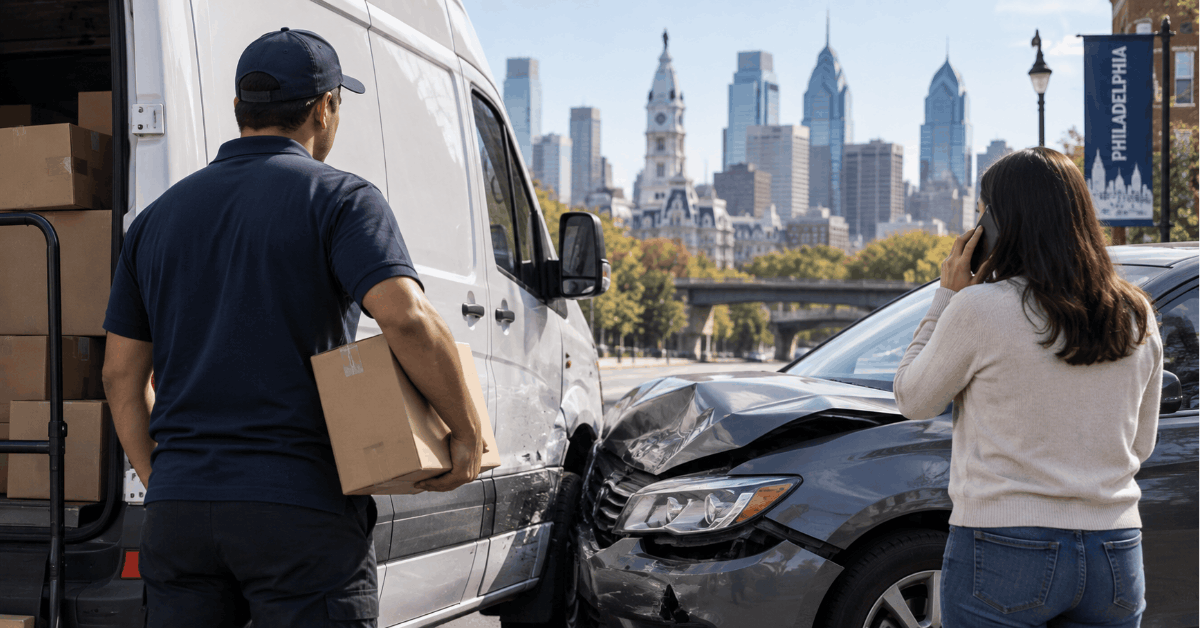
If you are currently going through this ordeal, you need an experienced car accident lawyer who can help guide you through the legal process. Car accidents involving delivery drivers may involve unique legal aspects that are not involved in a typical car accident case. Cousin Benny Injury Lawyers has experience handling all types of accident claims and can ensure that you understand your legal rights. Contact our dedicated legal team today for a free no-obligation consultation.
What Makes Accidents with Delivery Drivers Different Than Other Types of Auto Cases?
Accidents involving delivery drivers differ from typical car accidents because they often involve multiple corporate layers, complex insurance policies, and multiple parties and insurers. Some of the differentiating factors include the following:
Different Causes of Accidents
While car crashes with delivery drivers can be caused by some of the same reasons as other crashes (such as failing to yield the right of way or running a red light), they can also be due to unique causes associated with the driver’s job, such as the following:
- Work pressures: The pressures of some delivery drivers are well-documented, showing that many of these workers must run to drop off packages and not have time to take rest stops. Unrealistic delivery deadlines can cause workers to feel pressured to make deliveries faster. This can lead to dangerous driving habits such as speeding, driving aggressively, and disobeying the rules of the road.
- Distractions: Delivery drivers are performing dual roles during their job because they are driving and trying to complete their work at the same time. This means that they are likely to encounter more distractions, including updates about deliveries, messages from dispatchers, constant GPS checks, and calls about changes or deliveries. Distractions significantly increase the possibility of motor vehicle accidents.
- Unfamiliarity with the area: Drivers who are not familiar with the area may be paying more attention to GPS instructions or maps than the road in front of them. They could also make dangerous driving maneuvers if they discover they have missed their turn.
- Mechanical problems: Because delivery drivers log more miles on the vehicle they drive to complete their work duties, and repairing the vehicle could effectively prevent the driver from working, vehicle maintenance may be deferred. This could contribute to accidents caused by mechanical issues.
- Frequent sudden stops: Delivery drivers may make sudden stops frequently, catching other motorists off guard. Sometimes, they may stop in dangerous locations.
- Backing up: Some crashes are caused by drivers backing up in large vans or delivery trucks.
Vicarious Liability
Vicarious liability is a legal concept that holds someone else responsible for another party’s actions. The most common form of vicarious liability is an employer’s responsibility for the negligence of their employees, a legal doctrine called respondeat superior. Often, employers are automatically held responsible for the negligence of their employees, so if you are involved in an accident with a delivery driver who has an employer, the employer could be held responsible for it.
Gig Workers
Many delivery drivers today are not direct employees of the company for whom they are delivering. Instead, they may work for another company that provides an app or technical service to facilitate the delivery. These workers are commonly referred to as “gig workers.” In accidents involving gig workers, the company may or may not offer insurance to those who deliver for them.
Special Government Rules
Some delivery drivers, such as those who work for the United States Postal Service (USPS), operate under different rules. Accidents involving these drivers must proceed under the procedures laid out in the Federal Tort Claims Act.
Different Insurance Coverage
One of the most complicating factors of motor vehicle accidents involving delivery drivers is that different insurance policies can apply. Commercial auto insurance may apply if a traditional business is involved. Transportation network companies also generally provide liability insurance for their drivers. Corporate insurance policies tend to provide higher amounts of insurance than traditional personal liability policies, but insurance companies may be more likely to fight these claims to minimize their financial exposure.
The driver’s personal auto insurance policy could apply, but insurance companies often deny coverage if the driver was operating a vehicle for business purposes and did not have special insurance. It may be necessary to file a claim with the driver’s personal policy before another policy applies.
On-the-Clock Status
The company’s liability or their insurance policy may only apply if the driver was technically on the clock when the crash occurred. It may be necessary to obtain evidence regarding the app status or trip logs to prove the driver was on an active delivery at the time the accident occurred.
Availability of Technical Evidence
These accidents could involve various types of evidence that may help prove liability, such as:
- App-activity logs
- GPS tracking data
- Corporate dispatch records
- Onboard camera footage
- Dash cam footage
- Vehicle maintenance files
- Personnel files
- Background check records
Having an experienced personal injury lawyer is crucial to ensure this valuable evidence is not lost, destroyed, or overwritten.
Common Types of Delivery Drivers in Philadelphia
As a bustling city, many different types of delivery drivers can be spotted around Philadelphia, including the following:
- Amazon delivery drivers: Workers in vehicles emblazoned with the Amazon emblem, workers who work for local delivery service partners, and Amazon Flex workers who use their own vehicles to make deliveries
- Postal workers: Federal USPS workers
- Construction vehicles: Drivers who transport construction materials, including city and state vehicles
- Package deliveries: UPS, FedEx, DHL, and workers of other package delivery companies
- Passenger vehicle transporters: Lyft, Uber, and other rideshare services that transport passengers
- Meal-delivery drivers: DoorDash, Postmates, Uber Eats, and Grubhub
- Restaurant delivery drivers: Workers for pizza companies, sandwich shops, and major chains
- Grocery delivery servers: Workers from local grocery stores, Spark Delivery, Gopuff, or Instacart
- Furniture delivery drivers: Workers who deliver for furniture stores
- Freight drivers: Workers who move larger commercial furniture or industrial freight
- Box truck: Workers who use U-Haul, Penske, or other box trucks to make deliveries
- Florists: Workers for floral shops
Each of these types of workers can involve unique legal considerations regarding liability and insurance coverage. You need an experienced attorney who can identify your legal options based on your particular situation.
Who Is Responsible for an Auto Accident Involving a Delivery Driver?
Pennsylvania is an at-fault state for car accidents, meaning that the driver who is found at fault for the accident is responsible for paying for the car accident victim’s damages. Therefore, if the delivery driver is found at fault for the accident, they are responsible for compensating you.
However, the company that hired them could also be responsible for your damages or may maintain insurance that covers the driver’s negligence, depending on the type of driver and company involved. If the driver is employed by the company, their employer is generally responsible for paying for their negligence.
However, if the driver is an independent contractor, they may or may not be covered by the company or additional insurance. Many of these drivers work in the gig economy, which is made up of independent contractors, consumers who request the service, and technology companies that connect the two. Since these workers are classified as independent contractors, the company is not usually held liable for the negligent actions of their drivers. However, they might provide insurance to help cover their negligence.
Delivery Drivers and Insurance Coverage
As explained above, if a delivery driver is employed by a company, their employer is generally responsible for their negligence. They may have insurance that covers this possibility, or they can be sued for compensation. Here is some information about some of the most popular delivery services and the insurance they provide:
- Uber and Lyft: Uber and Lyft’s insurance depends on the driver’s app status. If the driver is on the app but has not accepted a ride request, these companies provide $50,000 in bodily injury per person, $100,000 in bodily injury per accident, and $25,000 in property damage liability coverage. If the driver has accepted a ride request or is transporting a passenger, they provide up to $1 million in coverage.
- Uber Eats: Uber Eats offers liability insurance to drivers to use as a supplement to their personal coverage or to pay for damages that exceed their personal policy. This insurance provides up to $1 million in liability insurance, which is triggered when the driver accepts a delivery request. This company also offers liability insurance of $50,000 in bodily injury per person, $100,000 in bodily injury per accident, and $25,000 in property damage liability coverage when their drivers are marked “available” and not engaged in a delivery.
- Postmates: Postmates offers up to $1 million in liability insurance for drivers engaged in an active delivery. This coverage is only available if a driver maintains their own comprehensive and collision insurance policy.
- DoorDash: DoorDash also provides up to $1 million for drivers who maintain their own personal comprehensive and collision insurance policy. This insurance applies during active deliveries, which the company defines as being “in possession of goods to be delivered.”
- Grubhub: Grubhub does not offer liability insurance for its drivers.
Some of these companies also provide insurance to cover the driver’s property damage and other losses.
How to Prove Fault in a Car Accident Case
As the plaintiff in a personal injury case, you bear the burden of proving the other driver was at fault for the accident. Fortunately, your personal injury attorney can help obtain valuable evidence, such as:
- App data: App data can help show that the driver was working at the time of the accident and establish which insurance policy should apply.
- Accident reports: Your lawyer can request the police report, as well as reports sent via the app. These reports can contain valuable information about the accident, including whether the delivery driver was cited for violating a law, their employer’s information, and the police officer’s initial determination of fault.
- Event data recorders: Most contemporary vehicles have electronic systems installed in them that record crucial information, such as the speed, braking patterns, and direction of travel immediately before an accident.
- Videos of the accident: Traffic cameras, onboard cameras, dash cameras, or cell phone cameras made by accident victims or witnesses may have recorded the accident and the moments immediately after it.
- Witness statements: Objective witnesses often provide a crucial perspective when the drivers’ accounts differ.
Why You Need a Delivery Driver Accident Lawyer
An experienced car accident lawyer can help protect your rights throughout the legal process by:
- Explaining fault rules, including those involving vicarious liability
- Investigating the driver’s employment relationship and identifying all applicable insurance policies
- Communicating with employers, tech companies, and insurance companies on your behalf so that you don’t inadvertently damage your legal claim
- Calculating the full extent of your damages
- Advising you whether a settlement is fair or whether you should go to trial
Contact Cousin Benny Injury Lawyers today for a free consultation to learn more.
Contact Our Philadelphia Car Accident Lawyers Today
If you were involved in an accident with a delivery driver, you will likely need the assistance of an experienced attorney to obtain fair compensation. Available compensation may come down to proving that the driver was on an active delivery. A lawyer with experience handling rideshare and delivery driver accidents will know how to obtain telematics, electronic logs, GPS data, business records, and other valuable evidence.
Let Cousin Benny Injury Lawyers handle the legal complexities for you while you focus on your recovery. Contact us today for a free, no-obligation consultation.